

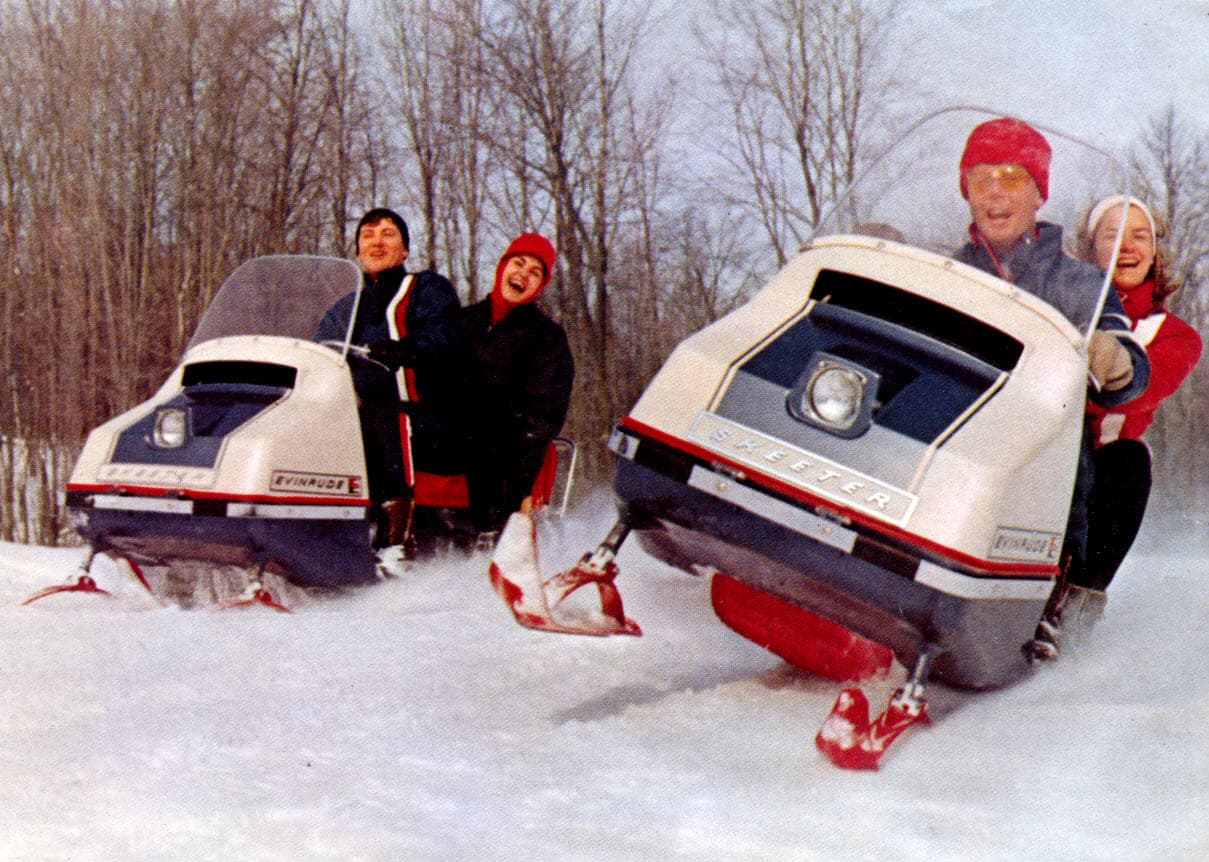

When a Marine Giant Takes His Shot on Snow
In the history of snowmobiling, few manufacturers have entered the market with as much financial strength, industrial experience, and technical credibility as OMC. Behind this acronym lies Outboard Marine Corporation, a true North American powerhouse in marine engines and the parent company of two legendary brands: Johnson and Evinrude.
At the turn of the 1960s and 1970s, as snowmobiling experienced explosive growth, OMC decided to transfer its mechanical and industrial expertise to the winter world. It was an ambitious venture, marked by heavy investment, bold technical choices, and real involvement in racing—one that would ultimately end with a gradual, then permanent, withdrawal from the market.
A Unique Industrial Context in Snowmobile History
Unlike most snowmobile manufacturers of the era—often small companies or newly created divisions—OMC entered the snowmobile market with a major advantage: decades of experience in two-stroke engine development, massive industrial production capacity, and a dealer network already firmly established across North America.
By the late 1960s, OMC was one of the world’s leading outboard motor manufacturers. The company had mastered:
- the design of high-performance two-stroke engines
- large-scale industrial production
- strict industrial quality control
- international distribution
In a still-young snowmobile market, this industrial strength appeared to offer every guarantee of success.
OMC’s entry into the snowmobile market
OMC entered the snowmobile world in the late 1960s, at a time when the industry was rapidly expanding. The strategy was clear: not to improvise, but instead to develop completed, well-structured, and technically credible products capable of competing with established leaders.
Rather than launching a new standalone brand, OMC chose to leverage the strong reputations of Johnson and Evinrude, two names already synonymous with mechanical reliability in the minds of North American consumers. This approach reassured buyers and capitalized on a well-established image of durability and performance.
A DNA Strongly Influenced by the Marine World
The DNA of OMC snowmobiles was deeply shaped by the company’s marine heritage. This influence appeared in several key areas:
- two-stroke engines derived from marine technologies
- a strong emphasis on reliability and durability
- a rigorous industrial approach rather than a handcrafted one
OMC engineers approached the snowmobile as a complete mechanical machine, designed to operate for long periods in harsh conditions, rather than as a lightweight recreational vehicle.
This philosophy produced snowmobiles often perceived as solid, powerful, and well built—sometimes at the expense of weight or agility compared to more specialized competitors.
A broad and ambitious lineup
By the early 1970s, OMC offered a surprisingly wide range of snowmobiles. The lineup covered several segments:
- utility snowmobiles
- trail and touring models
- sport and performance versions
- race-oriented machines
This diversity reflected OMC’s ambition to become a major player capable of addressing every type of snowmobiler.
OMC’s flagship snowmobile models (Johnson/Evinrude)
Johnson Skee-Horse
The Skee-Horse was one of the earliest iconic models associated with Johnson. It belongs to the first generation of modern snowmobiles and played a key role in OMC’s entry into the market.
Designed primarily for reliability and ease of use, the Skee-Horse appealed to riders looking for a rugged snowmobile capable of handling harsh winter conditions without demanding constant maintenance.
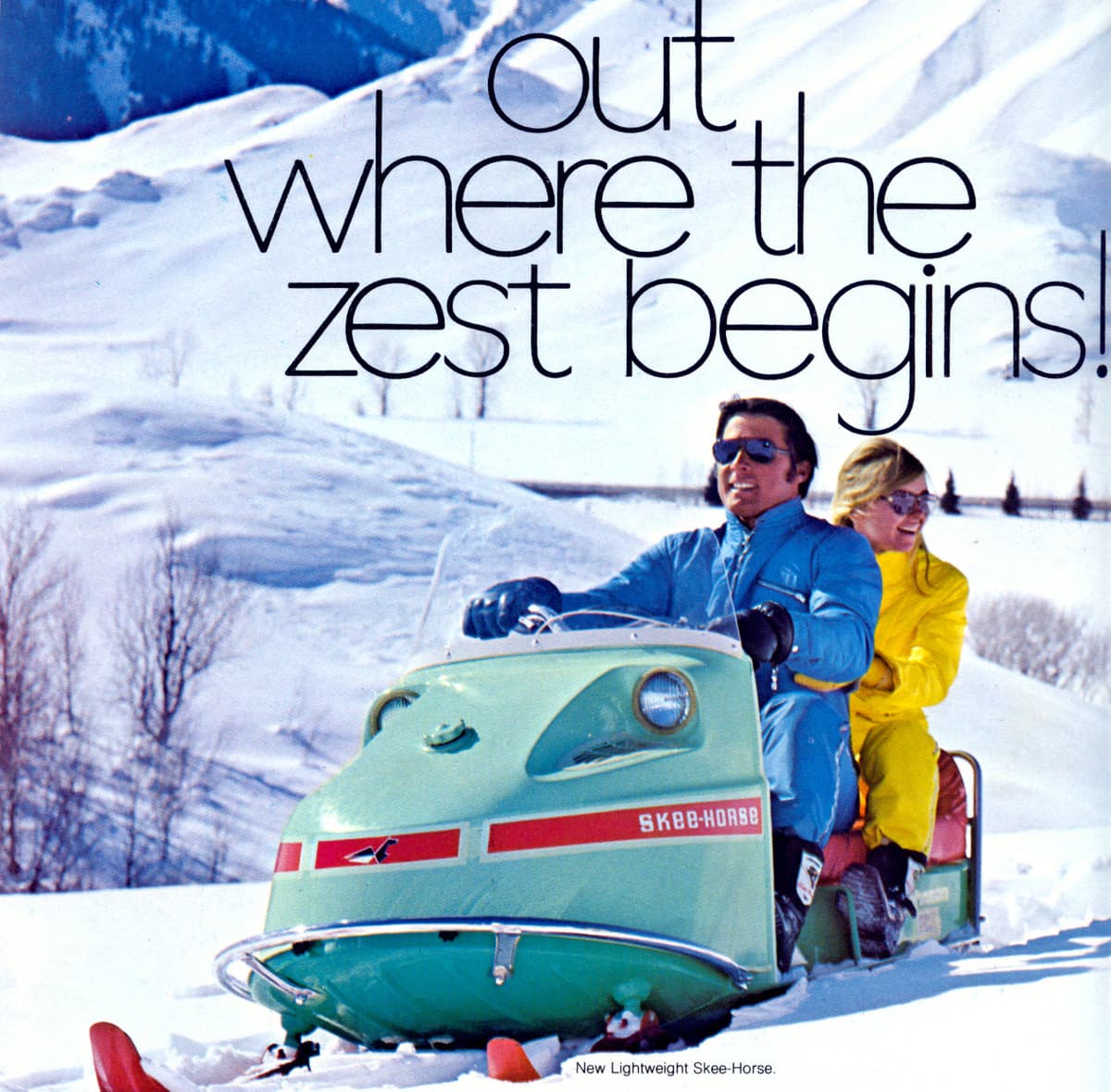
1970 Johnson Skee-Horse
Key features and innovations:
- Proven two-stroke powerplants
- Durable, heavy-duty construction
- Utility and recreational orientation
- Strong influence of OMC’s marine engineering expertise
Evinrude Bobcat
The Bobcat is one of Evinrude’s best-known snowmobiles. It targeted a broader audience by combining versatility, reliability, and sufficient performance for regular recreational use.
The Bobcat stood out for its serious design, dependable engine, and trail-friendly ergonomics, making it a popular choice among families and casual riders.
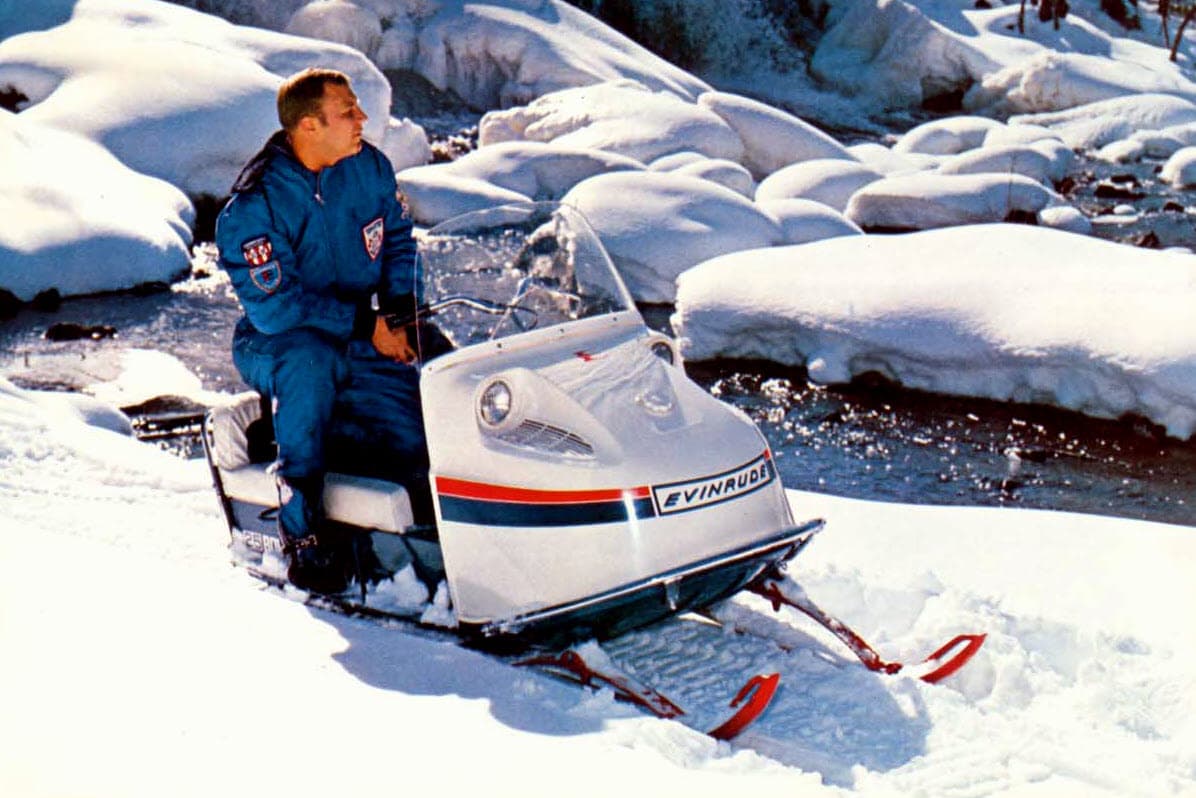
1970 Evinrude Bobcat
Key features and innovations:
- Accessible and versatile model
- Strong emphasis on mechanical reliability
- Predictable trail manners
- Wide distribution through OMC’s dealer network
Evinrude Skeeter
The Skeeter is one of Evinrude’s most emblematic models and perfectly illustrates OMC’s vision of snowmobiling in the early 1970s.
Positioned as a versatile recreational snowmobile, the Skeeter targeted a wide audience, from casual riders to regular winter trail users. It relied on robust construction, proven engines, and reassuring ergonomics consistent with OMC’s industrial DNA.
The Skeeter stood out for its mechanical simplicity, reliability, and ease of maintenance—highly valued qualities at a time when many snowmobiles required frequent attention.
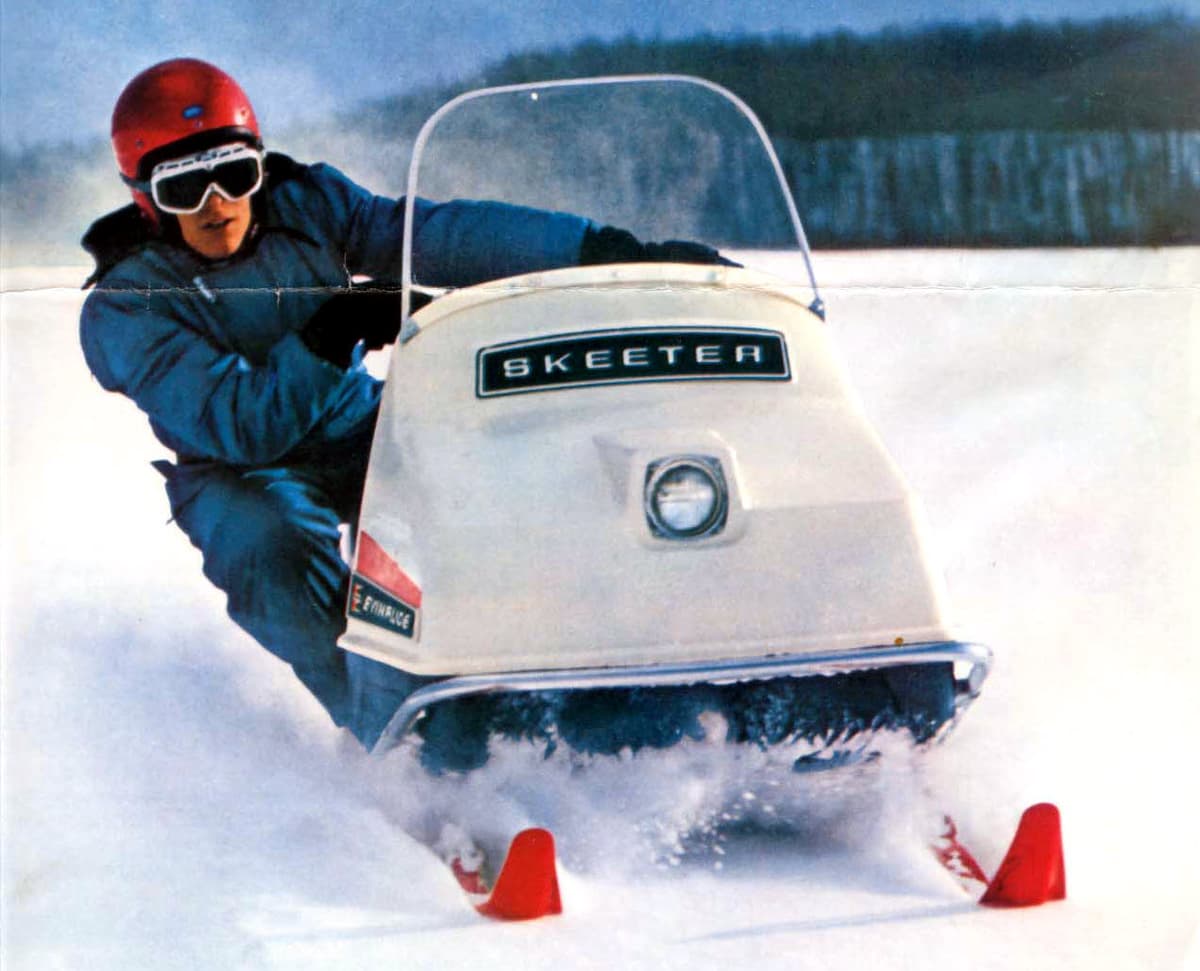
1970 Evinrude Skeeter
Key features and innovations:
- Recreational and versatile positioning
- Durable two-stroke engines
- Marine-inspired robust construction
- Easy maintenance and mechanical accessibility
- Wide distribution through Johnson/Evinrude dealers
Real involvement in snowmobile racing
Unlike some manufacturers that relied solely on marketing claims, OMC became actively involved in racing. The company quickly understood that competition served as both a technological laboratory and a credibility-building tool.
Johnson and Evinrude snowmobiles competed in:
- oval-track racing
- drag racing events
- local and regional competitions
This involvement allowed OMC to refine its engines, test higher-performance configurations, and demonstrate the durability of its products under extreme conditions.
The limits of an industrial giant on snow
Despite its considerable resources, OMC encountered several challenges unique to the snowmobile market.
First, the company’s corporate culture—focused on mass production and industrial reliability—proved difficult to adapt to a market where rapid innovation, weight reduction, and extreme specialization became critical success factors.
Second, the complexity of the product lineup and high production costs limited OMC’s flexibility compared to more agile competitors capable of quickly adapting platforms and technologies.
The economic shock of the mid-1970s
As with many manufacturers in this series, OMC’s snowmobile fate was heavily influenced by the economic climate of the mid-1970s.
A slowdown in the snowmobile market, combined with rising energy costs and widespread overproduction, forced large industrial groups to reassess their priorities.
For OMC, snowmobiles gradually became a secondary activity, less strategic than marine products—the historical and financial core of the company.
OMC’s gradual withdrawal from the snowmobile market
Rather than an abrupt collapse, OMC’s exit from snowmobiling occurred gradually. Investment declined, the lineup was reduced, and innovation slowed.
Ultimately, OMC chose to withdraw entirely from the sector, refocusing its resources on core marine activities. Despite its potential, snowmobiling no longer aligned with the group’s strategic priorities.
OMC’s Legacy in Snowmobile History
Although OMC’s winter adventure came to an end, its presence left a lasting mark on snowmobile history. Johnson and Evinrude demonstrated that an industrial giant could bring rigour, reliability, and power to a still-developing market.
Today, OMC snowmobiles are sought after by collectors and enthusiasts of rugged vintage machines—symbols of an era when the line between marine engineering and snowmobiling was thinner than one might expect.
OMC : power alone is not enough
OMC’s snowmobile story illustrates a key lesson in the industry: financial and industrial power does not guarantee success on snow.
Faced with more specialized, agile manufacturers deeply rooted in snowmobile culture, OMC ultimately failed to establish a lasting presence. Its story remains, however, a fascinating and instructive chapter in the history of discontinued snowmobile manufacturers.
Coming Up in the Series Former Snowmobile Manufacturers
In the next article, we will explore another iconic name in snowmobile history: Scorpion.