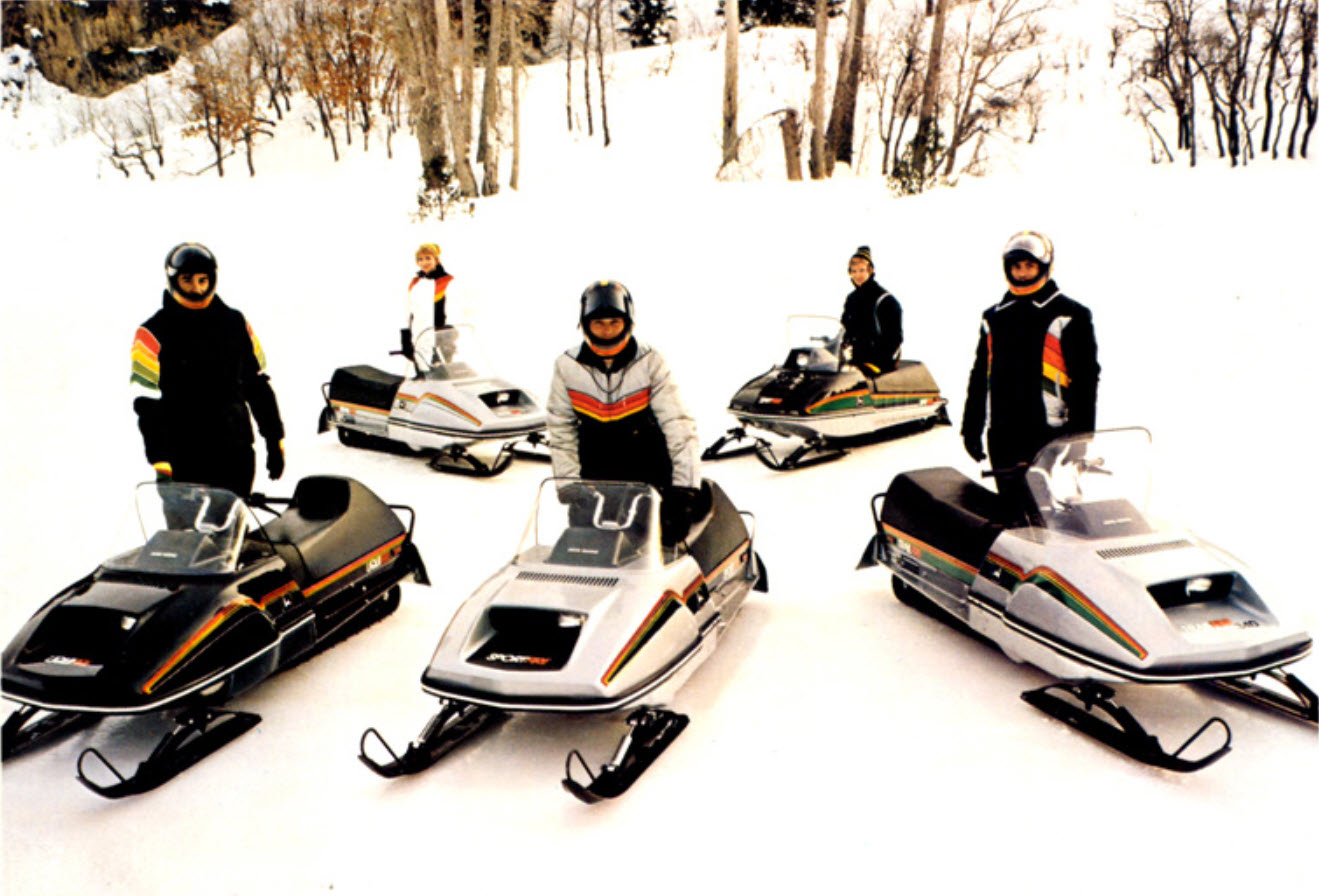
Today, the idea may seem surprising. Yet in the early 1970s, seeing John Deere enter the snowmobile world was anything but illogical. At the time, snowmobiling was a young, rapidly expanding market, still far from being locked down by a handful of dominant players. The industry was experimenting and innovating, and several manufacturers from other sectors were trying their luck.
For John Deere, the logic was straightforward:
a winter product could complement the dealer network’s offerings, keep showroom floors active during the cold season, and capitalize on well-established industrial expertise. The snowmobile thus became a serious project—not a mere curiosity.
Before the Snow: Why Snowmobile Manufacturers Diversified
By the late 1960s, snowmobiling was experiencing a true golden age. Sales were booming, trail networks were expanding, and popular enthusiasm attracted both passionate riders and major industrial players. John Deere observed the phenomenon closely.
Within the company’s offices, the snowmobile was seen as:
- a relatively simple mechanical product
- a market that was still flexible
- a logical extension of in-house know-how
Unlike other manufacturers that rushed in, John Deere took its time. The first prototypes appeared around 1971, following a rigorous development phase.
1972: John Deere Officially Enters the Snowmobile Market
In 1972, John Deere officially launched its first line of snowmobiles. From the outset, the tone was clear: there was no intention of playing the role of a marginal manufacturer. Their slogan “Nothing Runs Like a Deere,” already firmly established in the agricultural world, was reused as is. The message was clear: these snowmobiles would be built to the same robustness standards as the green-and-yellow tractors.
John Deere 400 and 500 Series Snowmobiles
- Kohler two-stroke engines, typically between 340 cc and 440 cc
- air cooling
- simple, accessible design
- easy maintenance

These models did not aim to impress with performance, but rather to reassure. They were intended for riders looking for a reliable, stable, and durable machine.
Mid-1970s: A Lineup Takes Shape
As the market matured, John Deere gradually expanded its offering. Unlike some competitors that multiplied variants, the brand favoured a coherent lineup.
Trailfire: John Deere’s Most Iconic Snowmobile
The Trailfire quickly became one of John Deere’s most popular models.
- engine displacements ranging from 440 cc to 600 cc
- well-thought-out ergonomics
- assembly quality often cited as a benchmark
- predictable and confidence-inspiring handling

Even today, the Trailfire remains one of the most sought-after John Deere snowmobiles among collectors, precisely because of its reliability and longevity.
Keeping Up with Snowmobile Technology Without Rushing
By the late 1970s, the snowmobile industry was evolving rapidly. Liquid cooling was gaining ground, particularly to improve performance consistency.
Liquifire: John Deere’s Technological Shift
With the Liquifire, John Deere demonstrated that it could follow industry trends without abandoning its philosophy.
- liquid-cooled Kohler engine
- improved thermal management
- more consistent behaviour in variable conditions
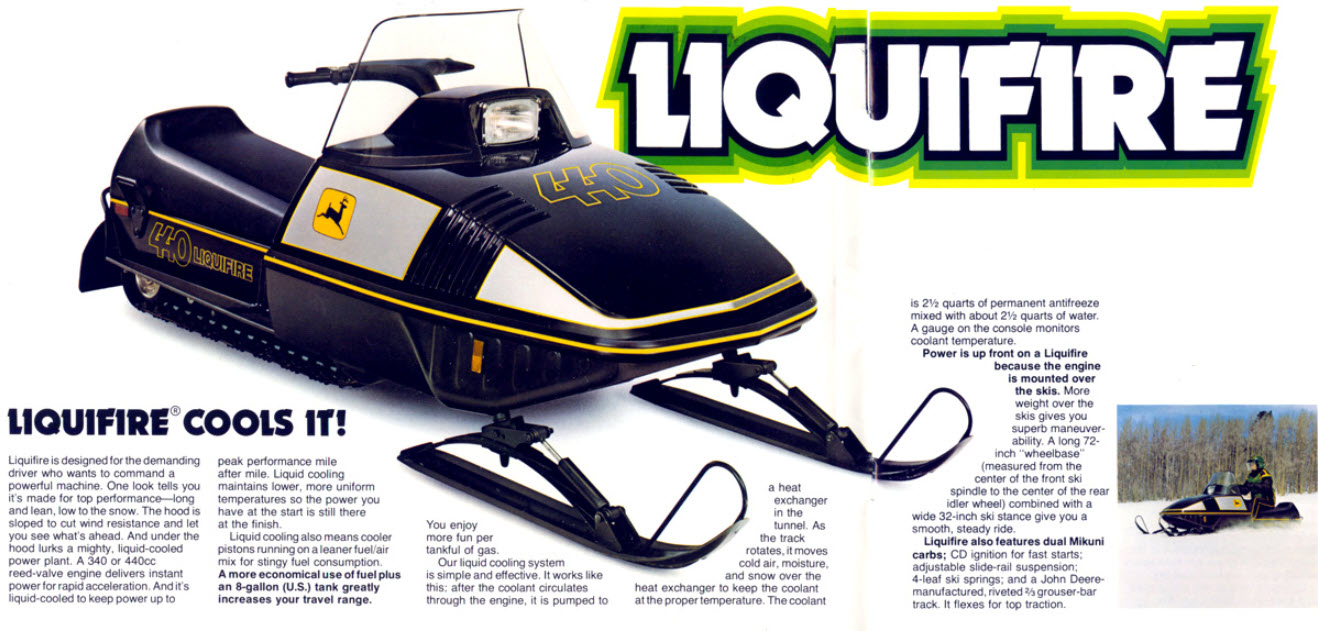
This model marked a turning point: John Deere was no longer limited to simple machines. It integrated more advanced solutions, but always with a conservative and reliability-focused approach.
John Deere’s Sporting Ambitions
Even though outright performance was not at the core of its DNA, John Deere still attempted to appeal to riders seeking sportier snowmobiles.
Cyclone and Spitfire: John Deere Sport Snowmobiles
- more aggressive design
- sport-trail positioning
- more powerful Kohler engines

These models were well built, but they arrived in a market where sport-oriented benchmarks were already using livelier powerplants (Rotax, Fuji). The result: respect for quality, but mixed enthusiasm when it came to performance.
They clearly illustrate the difficulty John Deere faced in stepping outside its industrial comfort zone.
1980: Peak Visibility
The year 1980 marked the peak of John Deere’s media visibility in snowmobiling. The brand became the official snowmobile supplier for the Lake Placid Winter Olympic Games.
This was a major recognition:
- validation of machine reliability
- international exposure
- a strengthened image of seriousness
But while John Deere shone in the spotlight, the market itself was beginning to contract.
When the Tide Turns for the Snowmobile Industry
In the late 1970s and early 1980s, reality set in:
- oil crises
- rising production costs
- slowing sales
- accelerated market consolidation
For many specialized manufacturers, it became a matter of survival.
For John Deere, it was a matter of priorities.
Snowmobiles remained a peripheral segment, far behind agriculture and industrial equipment.
1984: Why John Deere Exits Snowmobiling
In 1984, John Deere ended snowmobile production.
The decision was strategic, measured, and drama-free.
Snowmobile-related assets were sold to Polaris, a company then on the rise, which would leverage this industrial base to build its future.
Unlike many brands that disappeared abruptly, John Deere exited snowmobiling cleanly:
- support maintained for a period of time
- parts availability
- a structured dealer network

The John Deere Legacy Today
Forty years later, the legacy is still visible:
- many machines are still running
- reliability remains a widely recognized strength
- the brand retains immense respect within the “vintage” community
John Deere never sought to revolutionize snowmobiling.
Instead, it applied its industrial vision to a rapidly evolving market—before accepting that this particular trail was not meant to last long term.
Former Snowmobile Manufacturers: Lessons from the John Deere Case
The John Deere snowmobile episode is not a spectacular failure. It is the story of thoughtful diversification, solid execution, and a clear-eyed withdrawal at the right time. What a fascinating chapter in snowmobile history—one that reminds us that even giants must sometimes recognize that not all terrain is meant to endure. Each week, we will cover another snowmobile manufacturer that has disappeared. Next week, come back to learn more about Massey Ferguson/Ski Whiz.